


How Bad Does It Have to Get Before You Deserve Therapy?
A new therapy doodle series featuring some really thoughtful conversations :)



Over the years, I’ve realised that some of the conversations that happen in therapy can be surprisingly creative.
Therapy can be serious, of course. We talk about grief, trauma, relationships, shame, fear, and some of the hardest experiences in people’s lives.
But I also like to have fun in my sessions. Sometimes we draw things. Sometimes we invent strange metaphors. Sometimes a conversation goes somewhere neither of us expected, and we end up laughing about something that actually carries a fairly important insight underneath it.
One of my clients and I recently ended up creating an imaginary scoring system for suffering.
It started because she told me something I have heard in many different forms over the years:
“I don’t think I deserve to take up space in therapy.”
So I asked her a fairly obvious question.
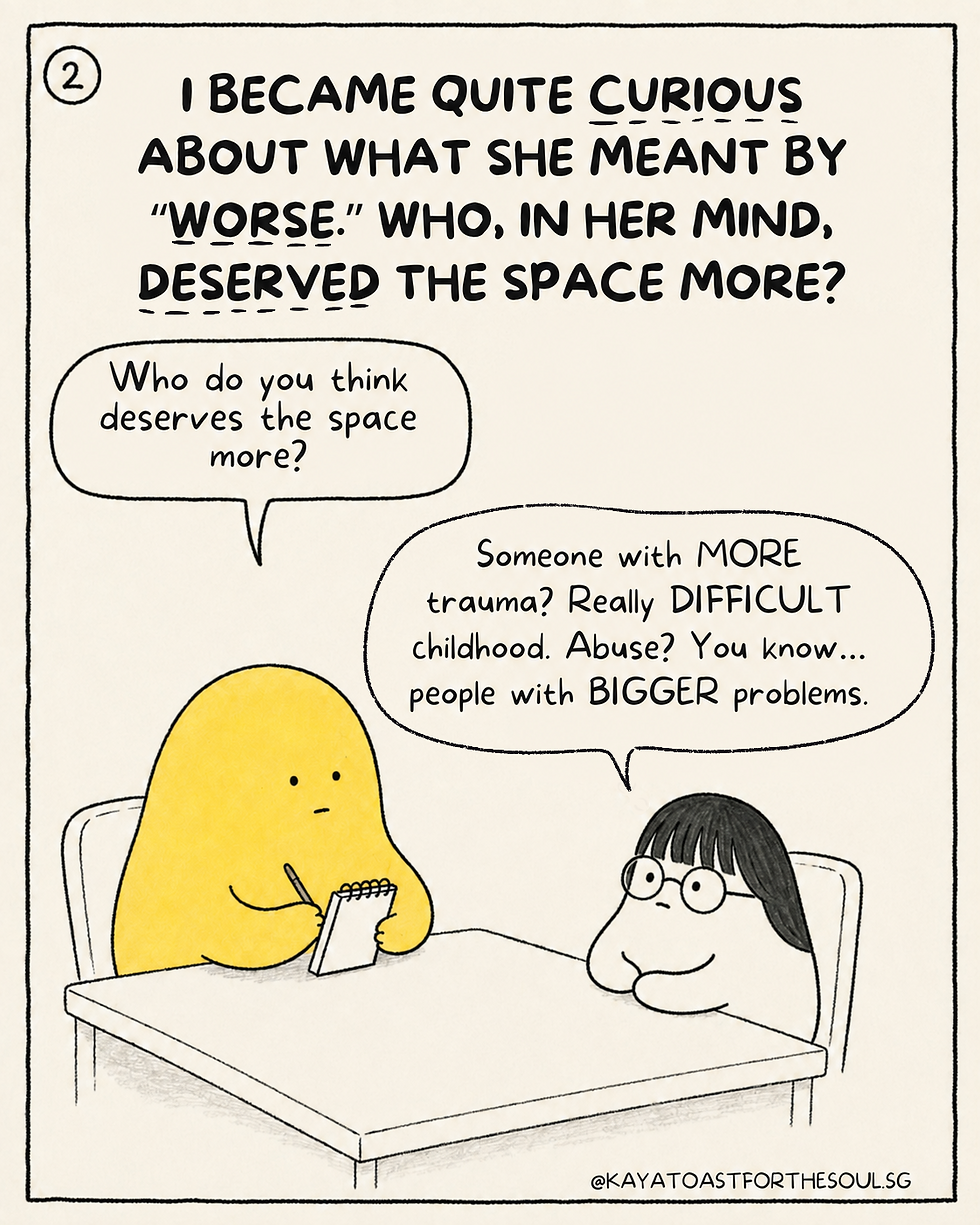
“Well… who do you think deserves this space then?”
And this was where things got interesting.
Apparently, somewhere in her mind, there was a threshold.
If your problems were serious enough, then yes, of course you deserved therapy. But how serious?
A six?
Maybe a seven?
An eight definitely sounded serious enough.
We started trying to work out where this imaginary line was, and eventually the whole thing became a little ridiculous.
What exactly were we scoring?
Trauma?
Suffering?
How badly your week was going?
And who was in charge of assigning the numbers?
We laughed about it together. For a while, our completely imaginary suffering scale became part of the conversation.
But underneath the absurdity was something very real. She genuinely believed that other people had suffered more than she had. And because of that, she felt she should need less.
Less help.
Less attention.
Less space.
This didn’t only happen in individual therapy either. In spaces where other people were sharing, she would sometimes find herself quietly calculating how much of the room she deserved.
My problems are only like this.
Other people have it worse.
Maybe I shouldn’t talk so much.
Someone else probably needs this space more than I do.
And I think this is something many people will recognise.
How Much Suffering Is Enough?
I can’t tell you how often some version of “other people have it worse” appears in therapy.
Sometimes people apologise before telling me what is bothering them. They tell me that what happened “wasn’t that bad”.
They compare themselves with someone who experienced something they consider more traumatic. Or they wonder whether coming to therapy itself is somehow excessive because they are still functioning, still working, still getting through their days.
There can be an unspoken idea that help belongs to people who have crossed some invisible threshold.
Until then, perhaps we should cope.
Push through.
Be grateful.
Leave the help for someone who “really needs it”.
And maybe this is part of the mental health stigma we still have to undo.
We have become much better at telling people to reach out for help. Yet many people still carry the belief that they first have to become unwell enough to deserve that help.
Which brings me back to my client and our ridiculous scoring system.
At some point, I asked her:
“Okay. Imagine someone comes to you and they’re only a three on our scale. They’re struggling, but apparently they’re nowhere near your threshold. Do they deserve someone to talk to?”
Her answer was immediate.
“Of course.”
There wasn’t much hesitation.
Of course that person deserved support.
Of course their pain mattered.
Of course they shouldn’t have to wait until things became worse.
So then came the much harder question.
Why not you?
The Rules We Apply Only to Ourselves
I think there was something important in that little contradiction.
Many of us are capable of enormous compassion when someone else is hurting.
If a friend told us they were struggling, most of us wouldn’t ask them to prove that their suffering had reached a seven.
We probably wouldn’t tell them to come back when their life had deteriorated a little further.
We wouldn’t pull out a spreadsheet and compare their pain with everyone else’s.
We would probably just recognise that someone we care about is having a hard time.
Yet when the suffering belongs to us, the rules can suddenly change.
We compare.
We rank.
We minimise.
We find someone who has experienced something worse and use their suffering as evidence that ours should not matter.
And perhaps there is an inner critic involved too.
A part of us that has learnt that our needs are excessive, that taking up space is selfish, or that asking for help requires justification.
The strange thing is that pain has never worked particularly well as a competition. Two people can experience something similar and be affected very differently. Something that feels manageable to one person can be enormously painful to another. The reverse can also be true.
Our histories are different.
Our resources are different.
The meaning we make of experiences is different.
The amount we are already carrying is different.
There really isn’t a useful universal scoring system for any of this.
You Don't Have to Earn Your Space
I think this is what I ultimately wanted my client to see. There isn’t a limited amount of deserving in the room. Someone else having a painful story does not make your story less painful. Someone else needing support does not mean you need it less.
And another person's suffering being real does not make yours unreal.
Perhaps the more useful question was never:
“Is my problem bad enough?”
Maybe it is simply:
“Is this difficult for me?”
Because if something keeps hurting, frightening, exhausting, confusing, or weighing on you, I think that is already worth paying attention to.
You don’t need to wait until the imaginary number gets higher. You don’t need to become less functional. You don’t need to fall apart first.
And you certainly don’t need to prove that you have suffered more than somebody else.
Our imaginary scoring system did not survive very long.
It was never particularly good at measuring anything anyway.
But I think I’m going to remember it.
Because sometimes the beliefs we carry become much easier to see when we put them outside ourselves for a moment and realise just how strange the rules are.
A three deserves kindness.
A six deserves kindness.
An eight deserves kindness.
And wherever you have decided you fall on your own imaginary scale today, perhaps you deserve some too.
Take care,
Hernping


Comments